


Is ACL Surgery 100% Successful? Understanding Success Rates, Recovery, and Results
The most grievous and one of the most frequent in general knee injuries is an ACL (Anterior Cruciate Ligament) tear, which is a problem mainly concerned with sports persons and active individuals. A question that one might hear from the mouth of the patient before the operation is, “Is ACL surgery 100% successful?” Only because of medical and particularly orthopedic and arthroscopic surgical advances, ACL reconstruction has been turned into a very dependable way of stabilizing the knee again.”
It is a patient wonder if the surgery will succeed absolutely. The answer to this question lies in the surgical records, the factors that improve or worsen the outcome and the specialists’ suggestions regarding the period after the surgery.
What Is ACL Surgery?
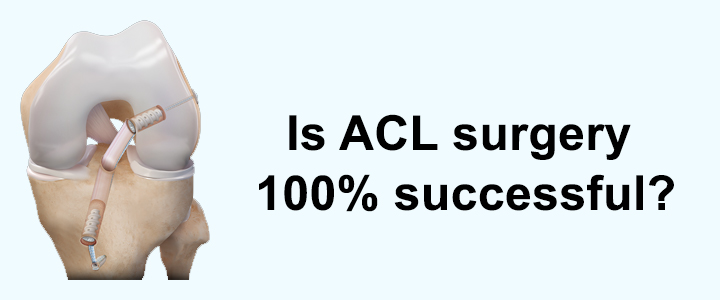
The Anterior Cruciate Ligament (ACL) is one of the major ligaments that support the knee joint structurally. This ligament may be damaged by sudden twisting or performing explosive movements in sports or hitting and being involved in a car crash. When the ligaments have been ruptured completely, there has been no case in which the regeneration took place by itself and hence the ACL reconstructive surgery is the one to be equipped.
The operation they do on the ACL consists of changing the torn section with a piece of tissue (most of the time this is the procedure where they take the hamstring or the patellar tendon from the patient’s leg). What they carry out here is a substitute that will later be one with the body, which will eventually lead to the restoration of the normal functioning of the knee.
The objective of today’s ACL repairs is to conduct it with the least possible harm on the body. For that, the doctor uses an arthroscope, which is a little camera placed in the space between small incisions and this helps in performing the operation with a few minutes of post-operative healing, little pain, and less scar formation.
Is ACL Surgery 100% Successful?
The anterior cruciate ligament (ACL) surgery is very successful in most cases, but the success is not 100% in all cases, according to the research. Worldwide, the estimated percentage of ACL reconstruction is between 90 and 95 percent, which means that most patients achieve full knee function, stability, and strength.
Successfulness, however, is influenced by many factors such as the surgeons’ skill, the used graft type, the surgical technique precision, and the patient’s dedication to rehabilitation after the surgery.
Basically, ACL surgery is a powerful and reliable tool but still doesn’t work perfectly in every single case.
Factors That Influence the Success of ACL Surgery
The success of ACL reconstruction is primarily surgical precision, patient behavior, and recovery management-related. These are the crucial factors:
1. Surgeon’s Experience and Technique
The proper and most effective method in which the graft is fixed and the knee is realigned is the one a proficient and experienced doctor will provide. Hence, lack of stability in the knee and eventual failure of the therapy can be the outcomes if the graft at the bought is not properly positioned.
For instance, among the best surgeons in Delhi performing ACL, Dr. Shekhar Srivastav, employs advanced arthroscopic methods and personalized techniques for perfect results.
2. Type of Graft Used
There are two main types of graft: one is an autograft (tissue taken from your body) and the other is an allograft (from a donor). In general, autografts tend to have better results in the long run since they are more biologically compatible.
3. Post-Surgery Rehabilitation
Physiotherapy and rehabilitation, if done correctly, will bring about the fastest recovery. Not even the most perfect intervention can result in failure if the surgical site is neglected during the post-operative stage. Rehabilitation should include strength, stretching, and balance exercises through which the new ligament will get used to and stabilize the knee joint.
4. Patient’s Lifestyle and Health
Refusal to comply with doctors’ orders, being overweight, or going back to playing sports too soon may cause another injury of the same knee. Taking care of your body through healthy eating, progressive return to sport, and at the same time losing if you are overweight, will give you a good chance of success in the long run.
5. Realistic Expectations
Knee injuries, each by themselves, are quite different. Most of the time, patients get back 90–100% of the knee power. However, a few of them can still feel mild stiffness or a slight ache from time to time. That is why working out realistic recovery goals with your doctor will make you feel contented with the results.
Common Reasons Why ACL Surgeries Fail
In very few cases, a small percentage of patients may complicate, or their outcomes may be unsatisfactory. Some of the reasons are:
- Surgical error – bad placement of the graft
- Poor rehabilitation or skipping physiotherapy sessions
- Graft rupture due to sports return too soon
- Post-surgery stiff joint or infection
- The surrounding muscles that have become weak and cannot support the reconstructed ligament
Most of these problems can be solved if one gets a timely diagnosis, correct instructions, and follow-up treatment from a reliable ACL specialist.
How to Maximize the Success of ACL Surgery
In case you are considering the reconstruction of the ACL, then implementing some or all of the following tips will be beneficial for you:
- First, make sure that your surgeon is competent and an expert on the subject matter. Proper knowledge and experience count a lot. Certainly, a well-reputed and experienced orthopedic specialist, who has successfully done hundreds of ACL surgeries, is the right person to meet.
- Next is the importance of a rehab plan commitment. No physiotherapy is quite optional, on the contrary, it is the only way to a successful ending. Performance of the exercises advised by the therapist should be a routine task.
- It is wise not to think about sports immediately after surgery. Let your knee get well and strong. Normally, patients are allowed to come back to sports after 6–9 months.
- Moreover, eating right is equally important to other factors. Foods rich in protein, calcium, and vitamin D are what the body needs most for fast tissue healing.
- Your mental state counts a lot too together with the rest of the points. Having faith in yourself and being persistent during the recovery phase are the factors that will eventually bring success.
Success Stories and Real-Life Results
Quite a few athletes and fitness enthusiasts have managed to be as good as before the operation by undergoing successful ACL surgery. It appears from the studies that almost 9 out of 10 patients achieve full knee function and stability within 12 months.
One of such examples is the case of patients who receive treatment from proficient and highly-skilled medical personnel like Dr. Shekhar Srivastav — a trusted ACL specialist doctor in Delhi. These patients are the ones who commonly narrate great recovery outcomes with very few days of rest. His tailored surgical and rehabilitation program contributes to the patients’ quick recovery of both confidence and mobility.
When to Consult an ACL Specialist
If you have:
- Persistent knee instability or pain after an injury
- Difficulty walking, running, or climbing stairs
- Swelling and limited motion in the knee
- A popping sound at the time of injury
…then you should definitely see a specialist. A timely diagnosis can actually save the condition from getting worse and the treatment can be more effective.
Conclusion: Is ACL Surgery 100% Successful?
In short, an ACL surgery is not 100% successful but is one of the most efficient orthopedic operations to be found nowadays.
Most patients, after an operation by an experienced ACL surgeon and proper recovery along with physiotherapy, are able to make a full recovery and return to normal or even athletic activity.
To put it another way, no surgical procedure can promise to be perfect, however, ACL reconstruction is as close as it gets to a solution for a full recovery of ligament tear, in particular, when it is carried out by a skilled ACL specialist doctor in Delhi like Dr. Shekhar Srivastav.
Related Posts
Orthopedic Doctor in Sant Parmanand Hospital
Orthopedic Doctor in Sant Parmanand Hospital – Your Complete Guide…
Second Time Around: What Makes ACL Revision Surgery Different?
Having ACL surgery once can be a big experience. So,…

Which Hospital is the best for Orthopedics in India?
Patients with chronic joint pain, fractures, sports injuries, or those…
One Reply to “Is ACL Surgery 100% Successful?”
Comments are closed.