
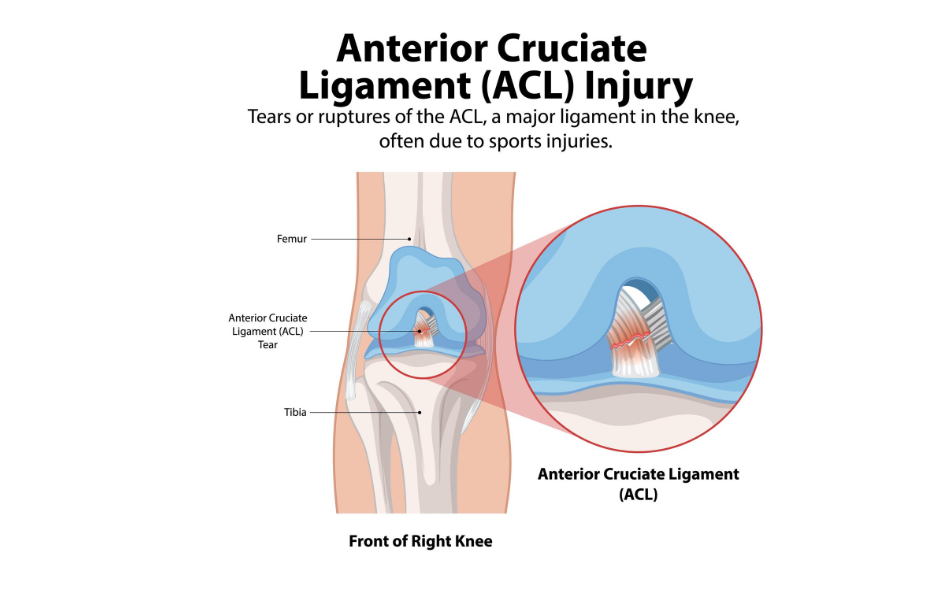
ACL Surgery Recovery
The surgery itself is over in a couple of hours. The recovery is the part that actually decides whether you get your knee back the way it used to be. That’s not meant to sound discouraging — it’s meant to set expectations correctly, because the single biggest predictor of a good ACL outcome isn’t how technically perfect the surgery was, it’s how closely the months afterward are followed. Patients who understand what’s actually supposed to happen at each stage tend to do noticeably better than patients who are just waiting for the knee to “feel normal” and guessing from there.
Realistically, expect walking unaided within two weeks, light jogging around the three-month mark, and a full return to competitive, pivoting sport somewhere between eight and nine months — sometimes later, depending on the sport and how strength testing goes along the way. What happens in between isn’t a straight line. It’s a series of distinct phases, each with its own goals, and skipping ahead of them is where most avoidable setbacks come from.
The First 24 Hours: More Active Than People Expect
Most patients are surprised that they’re up and walking, with a brace and a cane for support, the same evening as the surgery. This isn’t rushed or risky — early, controlled movement is actually part of good ACL protocol, helping circulation and reducing the stiffness that comes from a joint sitting completely still. Pain is managed with medication, ice is used regularly to control swelling, and the knee brace — usually locked in a way that limits how far it bends initially — protects the fresh graft while it starts settling into position.
Range-of-motion exercises, gentle ones, typically begin the very next day, guided by a physiotherapist. This early stage is entirely about controlling swelling, protecting the graft, and getting the quadriceps muscle “switched back on” — after knee surgery, the quad muscle often struggles to fire properly for a while, something physiotherapists specifically work on from day one rather than waiting for it to resolve on its own.
Weeks 1 to 2: Getting Off the Crutches
This is the phase most people focus on, understandably, because progress here is visible day to day. Hospital discharge is usually on day two or three. From there, the goal is steadily reducing dependence on crutches and the cane as quad strength and confidence return — most patients manage to walk without support somewhere between ten and fourteen days, though this genuinely varies based on how quickly individual muscle strength comes back, not a fixed calendar date.
Swelling control remains a priority throughout this stretch — ice, elevation, and compression alongside the physiotherapy exercises. Range of motion continues to be worked on gradually; a knee that’s too stiff too early becomes harder to loosen later, so consistent gentle movement matters even when it’s uncomfortable.
Weeks 3 to 6: Building the Foundation
Once basic walking is comfortable, physiotherapy shifts toward restoring full range of motion and starting genuine strengthening work — targeted quadriceps and hamstring exercises, balance training, and gradually more demanding movement patterns. The knee brace is often reduced or discontinued around this point, depending on the surgeon’s specific protocol and how the knee is progressing.
This phase is also when a lot of people start feeling noticeably better day to day — pain has usually settled substantially, walking feels close to normal, and it’s tempting to assume the hard part is over. It isn’t. The graft, biologically, is still in a relatively early and vulnerable stage of incorporating into the bone tunnels, even though the knee doesn’t necessarily feel that way anymore.
Months 2 to 3: Strength Becomes the Focus
This is where recovery gets more deliberately athletic. Physiotherapy moves into progressive resistance training, single-leg strength and balance work, and functional movement patterns that start to resemble real activity rather than isolated exercises. Stationary cycling and swimming are often introduced here as low-impact ways to build cardiovascular fitness without stressing the healing graft.
Light jogging is generally permitted somewhere around the three-month mark, though this is a genuine milestone that gets earned through strength benchmarks, not just counted off on a calendar. A physiotherapist typically wants to see reasonably symmetrical strength between the operated and non-operated leg, along with good control during basic movement, before introducing running.
Months 4 to 6: Reintroducing Real Movement
With a running base established, this phase adds agility work — cutting, pivoting, deceleration drills, and sport-specific movement patterns, all introduced progressively and under supervision rather than jumped into all at once. This is also typically when jumping and landing mechanics get specific attention, since poor landing control is one of the more common contributors to graft injury down the line, both in the reconstructed knee and, notably, in the other knee too.
Strength testing becomes more formal here in many rehab programs, often comparing the operated leg’s strength as a percentage of the healthy leg’s, alongside hop tests that measure distance, control, and landing quality. These numbers matter more than how the knee subjectively feels, because confidence tends to outpace actual biomechanical readiness at this stage — which is exactly the gap that leads to reinjury if it’s not properly assessed.
Months 7 to 9: The Actual Return to Sport
Full return to competitive, high-pivot sport is generally somewhere in this window, though it’s genuinely individual — some athletes clear return-to-sport criteria earlier, others need longer, and the sport itself matters too, since a straight-line sport like running has different demands than football or badminton with constant direction changes. A good rehab program uses objective testing at this stage — strength symmetry, hop test performance, and sometimes movement-quality screening — rather than clearing someone to return just because enough months have passed.
This is worth emphasizing plainly: time alone doesn’t heal an ACL graft to full readiness — the graft needs both biological maturation and the surrounding muscles need to be strong and coordinated enough to actually protect the knee during high-demand movement. Rushing this final stage because a knee “feels fine” is the single most common reason reconstructed knees get reinjured.
What Actually Slows Recovery Down
A few things reliably derail an otherwise good recovery. Skipping physiotherapy sessions or not doing the home exercise program consistently is the most common one — the surgery creates the opportunity for a stable knee, but the muscles around it have to be rebuilt through deliberate work, not passive healing. Returning to high-impact or pivoting activity before strength and hop-test benchmarks are actually met is another major one, often driven by a knee that feels good well before it’s biomechanically ready. Persistent swelling that isn’t addressed can also signal the knee is being pushed harder than it’s currently ready for, and ignoring it tends to slow overall progress rather than speed it up.
On the other end, being overly cautious — barely moving the knee out of fear of reinjury — can lead to stiffness and muscle wasting that then has to be worked back out of, adding time rather than saving it. The right pace sits in the middle: consistent, progressive loading guided by a physiotherapist, not driven purely by pain tolerance or purely by fear.
Why Structured Rehab Matters as Much as the Surgery
Two patients can have technically identical ACL reconstructions and end up with meaningfully different outcomes purely based on how their rehabilitation was managed. A structured program — one that actually tests strength and movement quality at each milestone rather than just tracking weeks on a calendar — is what closes the gap between “the surgery went well” and “the knee is genuinely ready for what you want to do with it.”
Dr. Shekhar Srivastav has 28 years of orthopedic surgical experience and is HOD of the Orthopedics Department at DITO, Sant Parmanand Hospital, Delhi, with extensive experience in arthroscopic ACL reconstruction and structured post-surgical rehabilitation planning.
Common Questions
How long does full ACL recovery actually take? Most patients return to daily activity within weeks and to full sport participation somewhere between eight and nine months, though the exact timeline depends on the individual, the sport, and how strictly rehab benchmarks are followed rather than a fixed date.
When can I drive again after ACL surgery? Generally once you can comfortably and safely bear full weight and control the operated leg without pain or hesitation — often around four to six weeks for a left-knee surgery in an automatic car, later for a right-knee surgery involving the brake pedal, though this should be confirmed with your surgeon based on your specific recovery.
Is it normal for the knee to still swell months after surgery? Mild swelling after activity can persist for a while as the knee continues healing, but persistent or worsening swelling is worth flagging to your surgeon or physiotherapist rather than assuming it will resolve on its own.
Can I go back to a desk job sooner than a physical one? Yes — many patients return to non-physical work within one to two weeks, while physically demanding jobs, especially those involving standing, lifting, or uneven terrain, generally require a longer period before returning safely.
What happens if I return to sport too early? The risk of re-tearing the graft, or injuring the other knee’s ACL, rises meaningfully when someone returns before strength and movement-quality benchmarks are actually met — which is exactly why objective testing, not just how the knee feels, should guide the return-to-sport decision.
If You’re Navigating Recovery Right Now
Whether you’re a few days post-surgery or a few months in and unsure if you’re actually on track, a proper in-person assessment against real strength and movement benchmarks is the most reliable way to know where you stand. Dr. Shekhar Srivastav and his team support ACL patients through the full recovery process at DITO, Sant Parmanand Hospital, and at Prime Speciality Clinic in Jagriti Enclave.
Call us on +91-9971192233 Sant Parmanand Hospital, Civil Lines, Delhi | Prime Speciality Clinic, Jagriti Enclave, Delhi delhiarthroscopy.com/arthroscopic-acl-reconstruction
Suggested Internal Links
- Arthroscopic ACL Reconstruction (pillar page)
- ACL Tear vs. MCL Tear: Key Differences and Treatment Options
- Knee Arthroscopy for Meniscus Tear
- Arthroscopic PCL Reconstruction
- Doctor’s Profile
Related Posts
Book Your Appointment with Dr Shekhar Srivastav at Sant Parmanand Hospital
In the world we live in today, which is very…
Which doctor is best for bones and joints?
If you have joint pain, fractures, arthritis, or sports injuries,…
Which is the best hospital for an ACL surgery in Delhi NCR?
Which is the Best hospital for an ACL surgery in…