
ACL Tear vs. MCL Tear: How to Tell Them Apart, and What Happens When Both Are Injured Together
Two people can describe almost the same injury — a twisted knee during a football match, a skiing fall, someone landing awkwardly off a scooter — and end up with completely different diagnoses. One turns out to have torn their ACL. The other, their MCL. And a fair number end up with both torn at once, which changes the treatment conversation considerably. Since these two ligaments sit close together and get injured in similar ways, it’s genuinely hard to tell them apart just from how the injury felt.
The short version: the ACL sits deep inside the knee and controls forward and rotational stability, while the MCL runs along the inner side of the knee and resists sideways stress. MCL tears, even fairly significant ones, often heal on their own with bracing and physiotherapy — no surgery required. ACL tears generally don’t heal that way and usually need reconstruction if the goal is returning to pivoting sport or trusting the knee on uneven ground again. When both are torn together, which happens more often than people expect, the treatment plan usually addresses them differently: the MCL is typically allowed to heal non-surgically first, while the ACL gets reconstructed once the knee has settled down enough.
Two Ligaments, Two Very Different Jobs
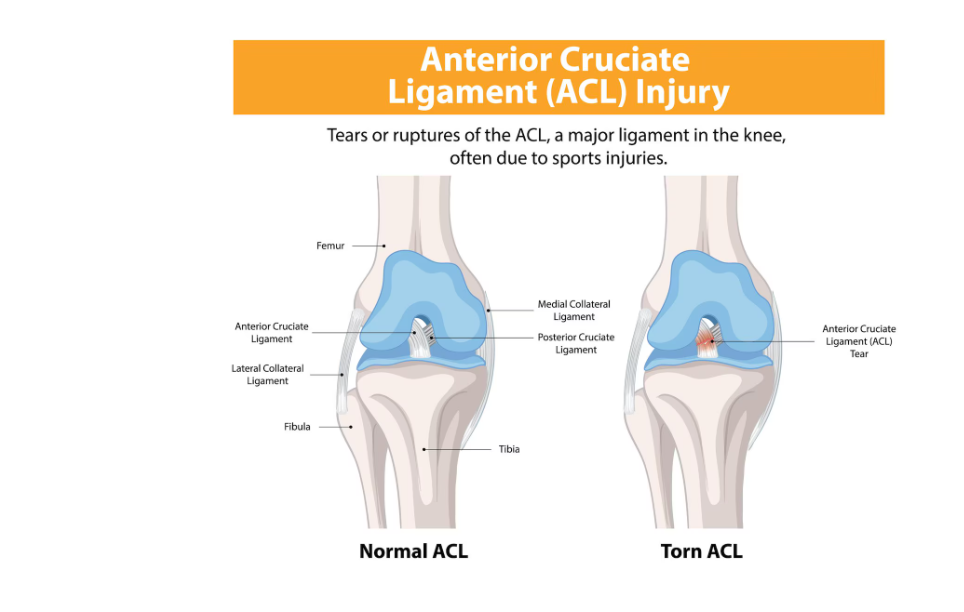
The knee relies on four main ligaments to stay stable, and each one resists a different kind of force. The ACL — anterior cruciate ligament — sits centrally inside the joint and mainly prevents the shin bone from sliding too far forward relative to the thigh bone, while also controlling rotational movement during pivoting. The MCL — medial collateral ligament — runs along the inner side of the knee, outside the joint capsule, and its job is resisting a knee being pushed inward, the kind of stress that happens when something hits the outside of the knee or the leg twists with the foot planted.
Because they resist different directions of force, the mechanism of injury tends to differ too. A pure MCL tear often comes from a direct blow to the outside of the knee, or a valgus (inward-buckling) stress without much rotation involved. A pure ACL tear more often comes from a sudden pivot, deceleration, or landing awkwardly, frequently without any contact at all. But knees rarely move in one clean direction during a real injury — a hard tackle or a bad fall can combine inward force with twisting, which is exactly the setup that tears both ligaments at once.
Telling Them Apart by How They Feel
Neither injury announces itself with a label, but the pattern of symptoms usually points somewhere specific.
An ACL tear classically comes with an audible pop at the moment of injury, swelling that develops fast — often within a couple of hours, largely from bleeding inside the joint — and a sense of the knee giving way or feeling unstable, particularly when pivoting or changing direction. Pain is present but sometimes less intense than people expect for what turns out to be a complete tear.
An MCL tear tends to produce pain and tenderness specifically along the inner side of the knee, often with visible bruising in that exact spot. Swelling is usually more localized than an ACL tear’s joint-wide swelling, and the knee often feels unstable specifically when weight shifts sideways — stepping awkwardly, or the leg buckling inward — rather than the rotational instability typical of an ACL tear.
When both are torn together, the picture blends — inner-knee tenderness and bruising alongside the fast, joint-wide swelling and instability more typical of an ACL injury. This overlap is exactly why symptoms alone aren’t a reliable enough basis for a diagnosis, and why a proper exam matters.
How the Diagnosis Actually Gets Made
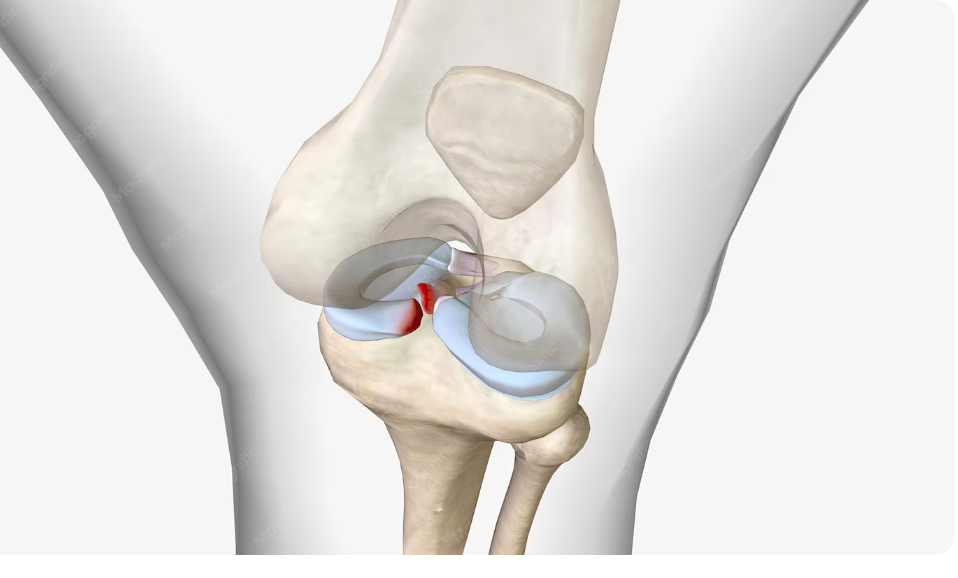
A hands-on clinical exam is the starting point, and it’s genuinely informative here — specific manual tests stress each ligament individually, checking how much the knee shifts under controlled inward pressure (testing the MCL) versus forward and rotational pressure (testing the ACL). A skilled examiner can often identify which ligament, or both, are involved before any imaging is even done.
An MRI confirms it definitively and does something the exam alone can’t — it shows the grade of each tear (how partial or complete), and importantly, whether the meniscus was also damaged in the same injury, which happens often enough in combined ACL-MCL injuries that it’s always worth checking for.
Why MCL Tears Are Usually Treated Differently Than ACL Tears
This is probably the most important practical difference between the two, and it surprises a lot of people. The MCL sits outside the joint capsule with a relatively good blood supply, which means it has a genuine capacity to heal on its own — even complete tears, in many cases — when given the right support. Treatment for an isolated MCL tear typically means a hinged knee brace that allows normal bending but blocks the sideways stress that would reopen the healing ligament, combined with a structured physiotherapy program to restore strength and motion as healing progresses. Surgery for an isolated MCL tear is fairly uncommon, generally reserved for a small subset of severe, unstable tears that don’t respond to bracing.
The ACL is a different story. Sitting inside the joint, bathed in joint fluid rather than a well-vascularized healing environment, it doesn’t reliably heal back together on its own once torn. For anyone wanting to return to pivoting sport, or simply trust the knee again on stairs and uneven ground, reconstruction using a tissue graft is generally the recommended path, since bracing and physiotherapy alone can improve strength around the joint but don’t restore the ligament’s actual mechanical function.
When Both Are Torn: How the Treatment Plan Actually Works
Combined ACL-MCL injuries need a bit of sequencing rather than fixing everything in one go. The common approach is to let the MCL heal first, non-surgically, using a brace over several weeks, while physiotherapy works on reducing swelling and restoring motion. Once the MCL has stabilized and the knee’s overall inflammation has settled — often somewhere around four to six weeks, though it varies — the ACL is then addressed through reconstruction.
There’s a practical reason for this sequencing beyond just convenience: operating on an acutely swollen, inflamed knee tends to carry a higher risk of stiffness afterward, so allowing the initial inflammation to calm down generally leads to a smoother ACL surgery and a better overall recovery. In more severe combined injuries, particularly where the MCL tear itself is very unstable, a surgeon may choose to repair both at the same time — but that decision is made case by case based on the exact grade and pattern of injury seen on the MRI, not a fixed rule.
Why Getting This Diagnosis Right Matters So Much
Treating a combined injury as if it were just an ACL tear — or missing the MCL component entirely — can leave residual instability even after a technically well-done ACL reconstruction, because the MCL’s job in resisting sideways stress was never properly addressed. Equally, rushing straight to ACL surgery on a knee where the MCL and surrounding inflammation haven’t settled can increase the risk of post-surgical stiffness. Getting a full, accurate picture — both ligaments, plus checking for meniscus involvement — before deciding on a treatment sequence is what actually protects the long-term outcome.
Dr. Shekhar Srivastav has 28 years of orthopedic surgical experience and is HOD of the Orthopedics Department at DITO, Sant Parmanand Hospital, Delhi, with extensive experience managing both isolated and combined knee ligament injuries, including ACL reconstruction, meniscus repair, and cartilage procedures.
Common Questions
Can an MCL tear heal without surgery? Yes, in most cases — the MCL has a reasonable capacity for self-healing given proper bracing and physiotherapy, and surgery is uncommon except for a subset of severe, unstable tears.
Can an ACL tear heal without surgery? Generally no — unlike the MCL, the ACL doesn’t reliably heal on its own inside the joint, and reconstruction is usually recommended for anyone wanting to return to pivoting or high-demand activity.
If both are torn, does the ACL get fixed immediately? Not usually. The common approach lets the MCL heal non-surgically first while inflammation settles, with ACL reconstruction following once the knee has stabilized — though severe combined injuries are sometimes managed differently case by case.
How do I know which ligament I’ve injured without an MRI? A skilled clinical exam can often distinguish between the two fairly reliably through specific stress tests, but an MRI is what confirms the diagnosis definitively and checks for additional damage like meniscus tears.
Is a combined ACL-MCL injury more serious than either alone? It generally requires more careful management and a longer overall treatment timeline, since two structures need to heal or be repaired in the right sequence, but with proper treatment, outcomes are still generally good.
If Your Knee’s Been Unstable Since an Injury
Inner-knee tenderness, a knee that buckles sideways, or a pop followed by fast swelling are all worth getting properly examined and imaged rather than guessing which ligament is involved. Dr. Shekhar Srivastav consults on ACL, MCL, and combined ligament injuries at DITO, Sant Parmanand Hospital, and at Prime Speciality Clinic in Jagriti Enclave.
📞 +91-9971192233 📍 Sant Parmanand Hospital, Civil Lines, Delhi | Prime Speciality Clinic, Jagriti Enclave, Delhi 🌐 delhiarthroscopy.com/arthroscopic-acl-reconstruction
- Arthroscopic ACL Reconstruction
- Knee Arthroscopy for Meniscus Tear
- Arthroscopic Meniscus Repair
- Arthroscopic PCL Reconstruction
- Doctor’s Profile
Related Posts
Minimally Invasive ACL Surgery Doctor Delhi
Minimally Invasive ACL Surgery Doctor Delhi – Advanced Care for…

What Is Shoulder Arthroscopy? Procedure, Benefits & Recovery Explained by Dr. Shekhar Srivastav
Shoulder pain and stiffness can limit even the simplest daily…

Experienced ACL Doctor Delhi
Experienced ACL Doctor Delhi – Trusted Knee Ligament Care for…