


Rotator Cuff Tear Symptoms You Should Never Ignore – Expert Advice by Dr. Shekhar Srivastav
Many people tend to overlook the pain in their shoulder as it is usually a sign of either muscle fatigue or a little strain. But, when the pain is persistent, you’re experiencing the weakness, and you find it hard to move your arm, it could be a rotator cuff tear. This is a shoulder injury that can disrupt your daily life quite a bit if you ignore it.
Identifying rotator cuff tear symptoms in the initial stages is the way to go to avoid additional injury and ensure successful treatment. No matter if you are a sports player, a desk worker, a craftsman, or an elderly person, knowing what signs to look out for is a must-do.
Dr. Shekhar Srivastav, a very skilled and knowledgeable shoulder and sports injury specialist in Delhi, is a specialist in diagnosing and treating rotator cuff injuries through advanced arthroscopic methods as well as customized rehabilitation programs.
What is a Rotator Cuff Tear?
These four muscles and tendons collectively called the rotator cuff are responsible for anchoring and moving the shoulder joint. You experience a tear if the tendon gets partially separated or entirely separated from a portion of the humerus.
Gradual degeneration due to repetitive movements of the shoulder and normal aging can cause rotator cuff problems. Besides, you might experience this when you fall down in an accident or get injured in sports.
The reasons behind a Rotator Cuff Tear
If you have a rotator cuff tear and you leave it without treatment, it can result in:
- Deterioration of the tendon
- Pain in your shoulder that lasts a long time
- You will not have enough strength in your shoulder
- Getting your arm moving is going to be a major task
- The state of frozen shoulder
- The muscles get weak
- You develop arthritis of the shoulder
- You are more likely to undergo surgery.
If a tear is found early, it often means a combination of therapy and surgery can be successfully avoided or at least postponed to a later date. The time lost also decreases substantially after a surgery.
10 Symptoms of Rotator Cuff Tear You Shouldn’t Ignore
1. Shoulder Pain Not Subsiding
Rotator cuff tear can be diagnosed with the help of pain lasting many weeks or months especially in the area over the shoulder.
Such discomfort might increase during lifting objects, stretching or when carrying something.
2. Pain When Raising Your Arm
The inability to raise up the arm overhead is one of the typical symptoms.
You will feel pain or hardship in the following daily activities:
- Comb hairs
- Packing up clothes
- Hanging kitchen shelves
- Putting on a dress
Getting dressed may be painful for you if there is rotator cuff tear.
3. Shoulder Pain Getting Worse Night
The shoulder pain at night is one of the major signs of rotator cuff tear.
Patients often mention:
- Not being able to lie on the affected side during sleep
- Waking up due to pain
- Feeling worse and worse on a day when you are busy
One should not take sleep disturbing shoulder pain lightly.
4. Lack of Strength/Weakness In the Shoulder
You may feel less capacity during:
- Carrying out groceries at home
- Carrying your bags
- Using heavy doors
- Doing the gym exercise
A muscle strain would not explain the weakness, rather the presence of a torn tendon would be more of an explanation.
5. Grating, Clicking Or Popping Sensations
Certain patients can hear or feel:
- The sound of a click
- The sensation of a grind
- The feeling of a snap
- Tearing noise, a pop
whenever the shoulder is moving.
Rubbing of the torn tendons on the adjacent structures produces these sounds.
6. Restricted Range of Movement
Range of motion is often affected in a rotator cuff tear injury.
You will face trouble in:
- Grooming in such cases
- Safety belts
- Playing volleyball
- Carrying out tasks involving raising hands
7. Pain During Sports or Exercise
The type of sports that involve the most shoulder injuries are;
- Cricket
- Tennis
- Badminton
- Swimming
- Volleyball
- Weightlifting
these kinds of athletes most likely to experience more severe shoulder pain while serving, launching the shuttle, ball, etc.
It is advisable to stop participating in an activity without medical examination because a tear can get worse.
8. Sudden Pain After a Fall
The rotator cuff muscles surrounding the shoulder can be injured in a fall if there is a trauma.
- A person is holding out his/her hand to the ground, and suddenly falls
- The person is caught in traffic accident.
- He/She gets shoulder dislocation
- He/She lifts a heavy weight
If after being hurt you realize you are no longer able to carry your arm in the air, do not hesitate, you better go to see the orthopedic specialist
9. Trouble Executing Everyday Activities
Around the clock activities turn into major tasks for those that can’t reach up. You will have problems;
- Driving
- Putting on clothes
- Cooking
- Cleaning
- Taking the kid to the bathroom
- Doing a job
When you have problems performing the activities of daily life for some time, then it might mean that the tendon is badly damaged
10. Shoulder Function Loss
In cases of massive injury, the person may even find it hard to raise the limb.
As soon as this occurs, seek help from a doctor without delay to avoid getting your shoulder permanently out of shape.
Why Do Rotator Cuff Tears Occur?
Different things can cause damage to the soft tissues like a tendon.
Weakening of Tendons Due to Old Age
Along with aging come degeneration of the joints and other supporting tissue, e. g., tendons and ligaments. It starts to show from 40 onwards.
Doing Repeated Overhead Tasks
The shoulder joint could be damaged little by little due to doing repetitive actions that require raising the arm high and then lowering it.
Risks of Sport-related Accidents
Games that involve overhead actions can strain the shoulder repeatedly. This is the case of throwing or hitting the ball from above.
Cracked Bones and Damaged Soft Tissue
Sudden and serious shoulder injuries can be the result of a fall, lifting something that is very heavy, or an accident.
Bad Ergonomic Posture
Poor posture over time can lead to pinching of the shoulder, which results in tearing of the supporting tissues.
Who Has a Higher Risk of a Rotator Cuff Injury?
We can mention you that your probability of an injury tear is higher in the following situations:
- You are over 40 yrs of age
- Your are participating in such sports
- that require a lot of moving above shoulder height
- Your occupational role requires physical activities related to construction, painting, or electrical works
- that make you lift heavy loads consistently
- Diabetes
- Smoking
- Prior history of shoulder problems.
When Will a Specialist for Shoulder Problems Recommend You?
The best option is to call a specialist when:
- Injuries are still hurting you after 10-14 days
- The pains from shoulder are making it difficult for you to sleep
- Weakness in movement of shoulder is evident
- Raised limb is a painful or impossible action
- After taking rest and medication symptoms do not improve
- Severe pain due to fall or any kind of accident
Consulting a medical professional at an early stage can prevent your shoulder from losing the ability it has.
What Is the Way of Diagnosing a Rotator Cuff Tear?
In his assessment, Dr. Shekhar Srivastav carries out a comprehensive check that may include:
Physical Exam
Special maneuvers test shoulder strength and tendon function.
X-ray
It is used to find out bone spurs, arthritis or any injury.
Sometimes only the MRI will be enough
In a MRI scan, one sees both bone and muscle in detail. So, the exact size and location of a tear is best found with MRI.
Scan via Ultrasound
This will be effective in checking out both small and large tears and movement of tendons.
What Treatments Are Available?
Treatment options will vary depending on tear size, patient age, level of physical activity and symptoms.
Treatment without Surgery
Much of the partial tears go away with the following measures:
- Easing the shoulder through rest periods
- Consuming medicines that bring down inflammation
- Exercises prescribed by a physiotherapist
- Application of cold compresses
- Changes in your lifestyle or daily routine
- Injectible anti-inflammatory (corticosteroid) therapy (if necessary) }}
- Injectible anti-inflammatory (corticosteroid) therapy (if necessary) }}
- Injectible anti-inflammatory (corticosteroid) therapy (if necessary)}}
Injury-Related Arthroscopic Rotator Cuff Reconstruction
The majority of severe tears or continued pain after a conservative treatment course will need a surgical intervention, minimally invasive arthroscopic rotator cuff repair.
Benefits associated with it are:
- Smallest number of surgical wounds
- Least amount of pain experienced
- The healing time is shortest
- Minimal risk of wound contamination is there
- Excellent looking outcome
- Work and leisure are quickly resumed.
What Happens to the Person after He/ She Gets Treated?
It depends on how severe the damage is that the shoulder’s ability to return to working fully is.
Average recovery process:
- 0, 6 Weeks: Wearing a sling, doing very light passive exercises
- 6, 12 Weeks: Increase in range of motion and physiotherapy sessions
- 3, 6 Months: Resistance training and resuming regular life activities
- 6, 9 Months: Engagement in sports or physical work
Taking part wholeheartedly in the physical therapy is necessary for achieving full recovery potential of the shoulder joint.
Ways to Prevent Rotator Cuff Injuries
Some effective tips are listed below to make your rotator cuff more vulnerable:
- Do some form of warm up exercises before engaging yourself in intense workouts
- Target muscle groups around the shoulder and the upper back areas through strength training
- Try to keep a good physical alignment at all times
- Avoid situations that require one to be repeatedly lifting an object over their head
- Ensure that you are practicing proper lifting methods
- If you are doing the same kind of activities over and over, give yourself short breaks
- If you have any kind of discomfort in the shoulder area, it is best that you consult a medical practitioner as soon as possible
Reasons to Select Dr. Shekhar Srivastav
Shekhar Srivastav, MD is a very popular ortho-trauma and sports injuries surgeon who is very skilled at shoulder arthropscopy and rotator cuff repair surgery among other things.
He is preferred by patients because of the following advantages:
- He is one of the pioneers in minimally invasive shoulder surgery which is less traumatic to the soft tissue and results in fast recovery.
- He provides accurate and reliable diagnosis with the help of modern imaging techniques.
- Each patient gets a custom-made treatment approach depending on his/her particular needs and situation.
- He utilizes scientific methods to plan and execute rehabilitation activities post-surgery that lead to better outcomes.
- The main goals for this kind of care include the removal of pain and the achievement of full movement of the shoulder joint in addition to shoulder strength.
In summary
Rotator cuff tears often have a slow development from the beginning (mild discomfort) to severe pain, weakness, and loss of shoulder function if left unattended. Symptoms like shoulder pain that keeps bothering you even during the night, arm weakness, and having difficulty lifting your arm are signs that you should pay attention to.
An experienced expert like Dr. Shekhar Srivastav can help you identify the right treatment early on so that you can avoid having complications besides you being able to return to your lifestyle, activities, and even sports with the least amount of hesitation or hesitation.
FAQ
1. What are the earliest signs of a torn rotator cuff?
The initial stages can be recognized through symptoms that consist of continual pain in the shoulder or shoulder pain, weakness, the inability to raise the arm or a sensation of resistance, and pain when resting.
2. Can you fix a torn rotator cuff without going through surgery?
In case the tear is small or just a tear and no tear in the muscle (partial tear), then conservative treatment by physiotherapy and medication should suffice and be enough. But, most of the cases would be either complete or near-complete tears (musculotendinous junction or more proximal), and the only option at present is to go for surgical repair.
3. Does pain during night time indicate rotator cuff tear?
Yes, the feeling is so bad in one night that the sleep is totally interrupted is among the very typical symptoms of a rotator cuff damage.
4. How is a rotator cuff tear diagnosed?
Doctors generally conduct a physical examination and may also perform scans like an MRI, ultrasound, or X-ray to confirm a diagnosis.
5. What happens if a rotator cuff tear is left untreated?
If a rotator cuff tear goes untreated, the damage can spread, resulting in constant pain, weakness of the muscles, less movement, frozen shoulder, and even arthritis in the shoulder joint.
6. How long does recovery take after rotator cuff surgery?
The majority of patients feel the effects of the surgery wearing off in 4, 6 months, whereas resuming full participation in sports and physically demanding tasks may require a longer healing time of around 6, 9 months.
7. Who should I consult for rotator cuff tear treatment in Delhi?
A qualified medical professional Dr. Shekhar Srivastav is specialized in treating shoulder and sports injuries in Delhi. He provides state-of-the-art arthroscopic procedures and fully supported post-operative care for individuals with problems of the rotator cuff.
Related Posts
What is the recovery time after ACL reconstruction in Delhi?
What is the Recovery Time After ACL Reconstruction in Delhi?…

Best Orthopedic Solutions in Delhi
Best Orthopedic Solutions in Delhi by Dr. Shekhar Srivastav If…
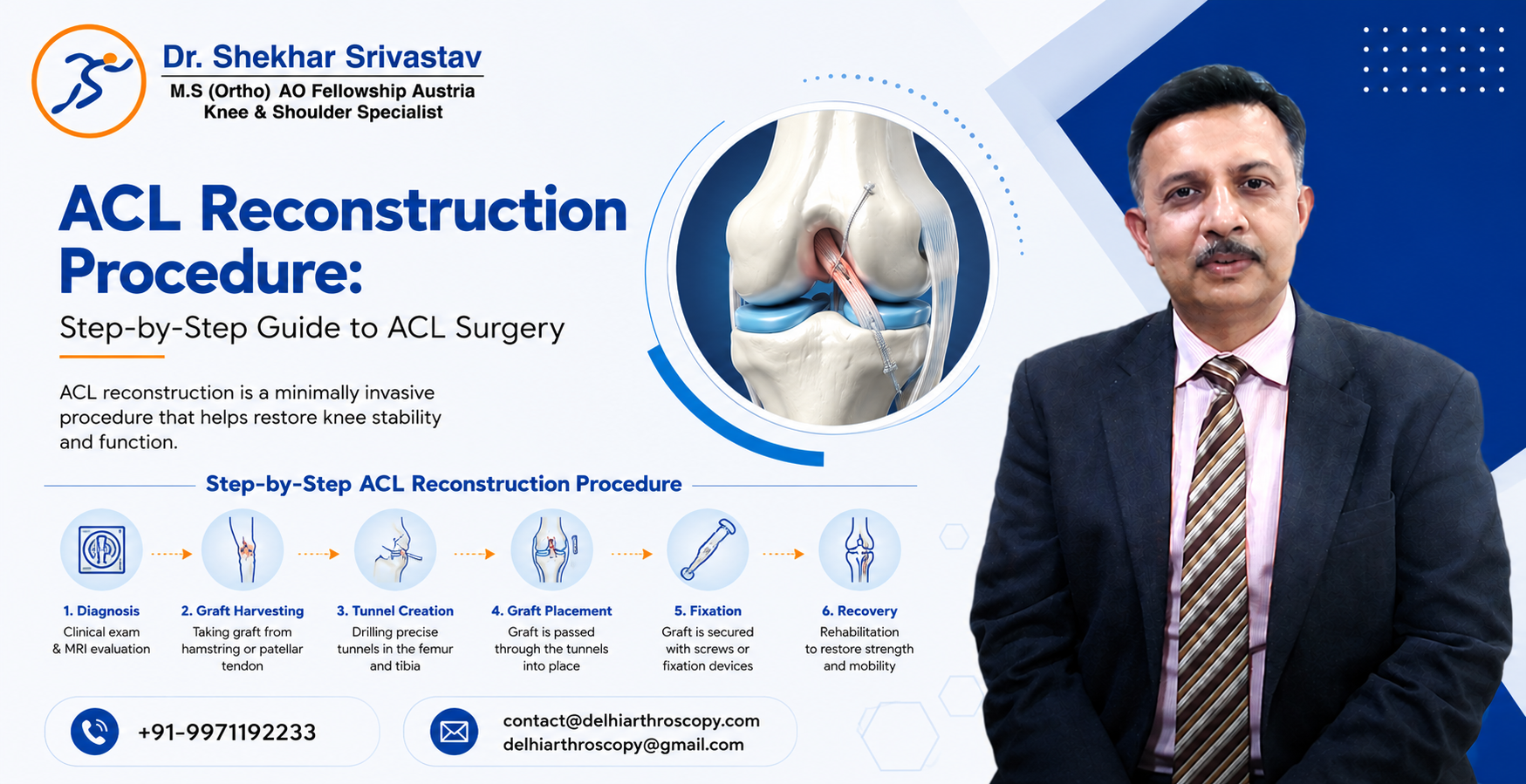
How does ACL reconstruction surgery work?
How does ACL reconstruction surgery work? ACL reconstruction surgery is…
One Reply to “Rotator Cuff Tear Symptoms You Should Never Ignore”
Comments are closed.