
Can a Teenager Have ACL Surgery? A Parent’s Guide to ACL Injuries in Young Athletes
A torn ACL can be a frightening diagnosis for a teenager, especially when sports are an important part of their life. Parents often ask: “Can a teenager have ACL surgery?” The answer is yes. Teenagers can undergo ACL reconstruction when it is medically appropriate, but the decision requires careful assessment of the child’s age, growth, activity level, knee stability, and the type of ACL injury.
For teenagers with an unstable knee, particularly those who want to return to sports such as football, basketball, cricket, badminton, or athletics, timely treatment can help protect the knee and reduce the risk of further injury.
What Is an ACL Tear?
The anterior cruciate ligament (ACL) is one of the major ligaments inside the knee. It helps control forward movement and rotation of the shin bone in relation to the thigh bone.
ACL injuries are common among young athletes. A teenager may tear the ACL while:
- Suddenly changing direction
- Landing awkwardly after a jump
- Stopping abruptly while running
- Twisting the knee during sports
- Suffering a direct sports-related impact
A “popping” sensation, knee swelling, pain, difficulty walking, and a feeling that the knee is giving way can occur after an ACL injury.
Can a Teenager Safely Have ACL Surgery?
Yes, ACL reconstruction can be performed in teenagers when surgery is indicated. However, children and teenagers are not simply treated like smaller adults.
One of the most important considerations is whether the teenager still has open growth plates. The growth plates are areas of developing tissue near the ends of bones that allow children to grow. ACL surgery must therefore be planned carefully to minimise the risk of growth disturbance.
Modern ACL reconstruction techniques can be adapted according to skeletal maturity. An experienced knee and sports surgeon evaluates the teenager’s growth status before deciding which surgical technique is appropriate.
Does Every Teenager With an ACL Tear Need Surgery?
Not necessarily.
Treatment depends on several factors. Some teenagers may be managed initially with physiotherapy, activity modification, strengthening exercises, and close follow-up. However, surgery may be recommended when the knee remains unstable or when the teenager participates in pivoting and cutting sports.
ACL reconstruction may be considered when there is:
- Repeated knee instability or “giving way”
- A complete ACL tear
- Significant sports participation
- Associated meniscus or cartilage injury
- Difficulty returning to normal activities
- A high risk of additional knee damage because of instability
The decision should be individualised rather than based on age alone.
Why Is ACL Surgery Sometimes Recommended for Young Athletes?
An unstable knee can potentially cause additional problems. Repeated episodes of the knee giving way may place extra stress on the meniscus and cartilage.
For an active teenager who wants to return to competitive sports, leaving an unstable ACL-deficient knee untreated may not always be the best long-term option.
The objective of ACL reconstruction is not simply to help an athlete return to the playing field quickly. It is to restore knee stability and create the best possible conditions for a safe return to activity.
What Happens Before ACL Surgery?
Before recommending surgery, the orthopaedic surgeon will usually perform a detailed clinical examination and review imaging such as an MRI scan.
The assessment may consider:
- Age and skeletal maturity
- Growth plate status
- Type and extent of ACL injury
- Meniscus or cartilage damage
- Level of sports participation
- Knee instability
- Overall physical condition
- The teenager’s rehabilitation commitment
Sometimes physiotherapy is recommended before surgery to reduce swelling, restore knee movement, and improve muscle strength.
What Is ACL Reconstruction in Teenagers?
ACL reconstruction involves creating a new ligament to replace the torn ACL. The surgeon uses a suitable graft, often from the patient’s own tissue, depending on the individual case.
In teenagers, surgical planning is particularly important because the surgeon must consider the developing skeleton and growth plates.
The exact technique and graft choice should therefore be decided after a personalised assessment rather than using the same approach for every young patient.
How Long Does Recovery Take After ACL Surgery?
ACL surgery is only one part of treatment. Rehabilitation is equally important.
Recovery commonly involves several stages:
Early recovery: Controlling pain and swelling and restoring knee movement.
Strengthening: Physiotherapy focuses on rebuilding strength in the quadriceps, hamstrings, hips, and core.
Balance and control: The teenager gradually works on coordination, stability, and movement patterns.
Sports-specific rehabilitation: Running, jumping, changing direction, and other sporting movements are introduced progressively.
Return-to-sport testing: The teenager should demonstrate adequate strength, control, and confidence before returning to competitive sport.
Return to sports should be based on functional recovery rather than simply the number of months since surgery.
When Can a Teenager Return to Sports After ACL Surgery?
This is one of the most important questions parents ask.
There is no single return-to-sport date that applies to every teenager. Returning too early can increase the risk of reinjury.
The surgeon and physiotherapist may assess:
- Muscle strength
- Leg-to-leg strength differences
- Balance
- Jumping and landing mechanics
- Knee stability
- Psychological readiness
- Sport-specific performance
The teenager should return to competitive sport only after meeting appropriate rehabilitation milestones.
What Should Parents Know About ACL Surgery?
Parents should understand that successful ACL treatment requires cooperation from the entire family.
A teenager may feel frustrated because they cannot immediately participate in sports or physical education. Consistent physiotherapy, appropriate activity restrictions, good nutrition, sleep, and regular follow-up all contribute to recovery.
It is also important to avoid comparing one teenager’s recovery with another athlete’s timeline. Every knee and every rehabilitation journey is different.
ACL Surgery for Teenagers in Delhi
Parents looking for ACL treatment for teenagers in Delhi should consider an orthopaedic surgeon experienced in knee and sports injuries, particularly in treating young and active patients.
For families in East Delhi, Shahdara, Karkardooma, Yamuna Bazar, and nearby areas, an early consultation can help determine whether an ACL injury requires physiotherapy, further observation, or reconstruction.
Dr. Shekhar Srivastav specialises in knee, hip, and shoulder conditions and evaluates ACL injuries based on the individual patient’s age, activity level, knee stability, and injury characteristics.
Frequently Asked Questions
1. Can a 15-year-old have ACL surgery?
Yes. ACL reconstruction may be performed in teenagers when medically indicated. Growth plate status must be considered when planning surgery.
2. Is ACL surgery safe for teenagers?
ACL reconstruction can be performed safely in appropriately selected young patients, particularly when the surgical technique is planned according to skeletal maturity.
3. Does every teenage ACL tear require surgery?
No. Some injuries may initially be managed without surgery. The decision depends on knee stability, activity level, associated injuries, and individual circumstances.
4. Can a teenager return to sports after ACL surgery?
Many teenagers can return to sports after completing a structured rehabilitation programme and meeting appropriate return-to-sport criteria.
5. Why is physiotherapy important after ACL surgery?
Physiotherapy helps restore movement, strength, balance, coordination, and sports-specific function.
6. Can ACL surgery affect growth?
Because teenagers may still have open growth plates, surgical planning must account for skeletal maturity and minimise potential growth-related complications.
7. What happens if a teenage ACL tear is left untreated?
An unstable knee may experience repeated giving-way episodes, which can increase the risk of additional meniscus or cartilage injuries.
8. When should parents consult an orthopaedic surgeon?
Persistent swelling, instability, pain, difficulty playing sports, or a suspected ACL injury should be evaluated by an orthopaedic specialist.
Final Takeaway
Yes, a teenager can have ACL surgery when it is medically appropriate. The key is not simply the teenager’s age but the overall condition of the knee, skeletal maturity, activity level, associated injuries, and long-term goals.
If your teenager has suffered a knee injury during sports and is experiencing swelling, instability, or repeated episodes of the knee giving way, an early orthopaedic evaluation can help determine the right treatment approach.
Dr. Shekhar Srivastav provides evaluation and treatment for ACL and other knee injuries in Delhi, helping young patients and their families understand their treatment options and rehabilitation journey.
Related Posts
Sant Parmanand Hospital Orthopedic Specialist
Sant Parmanand Hospital Orthopedic Specialist: Top Bone and Joint Care…
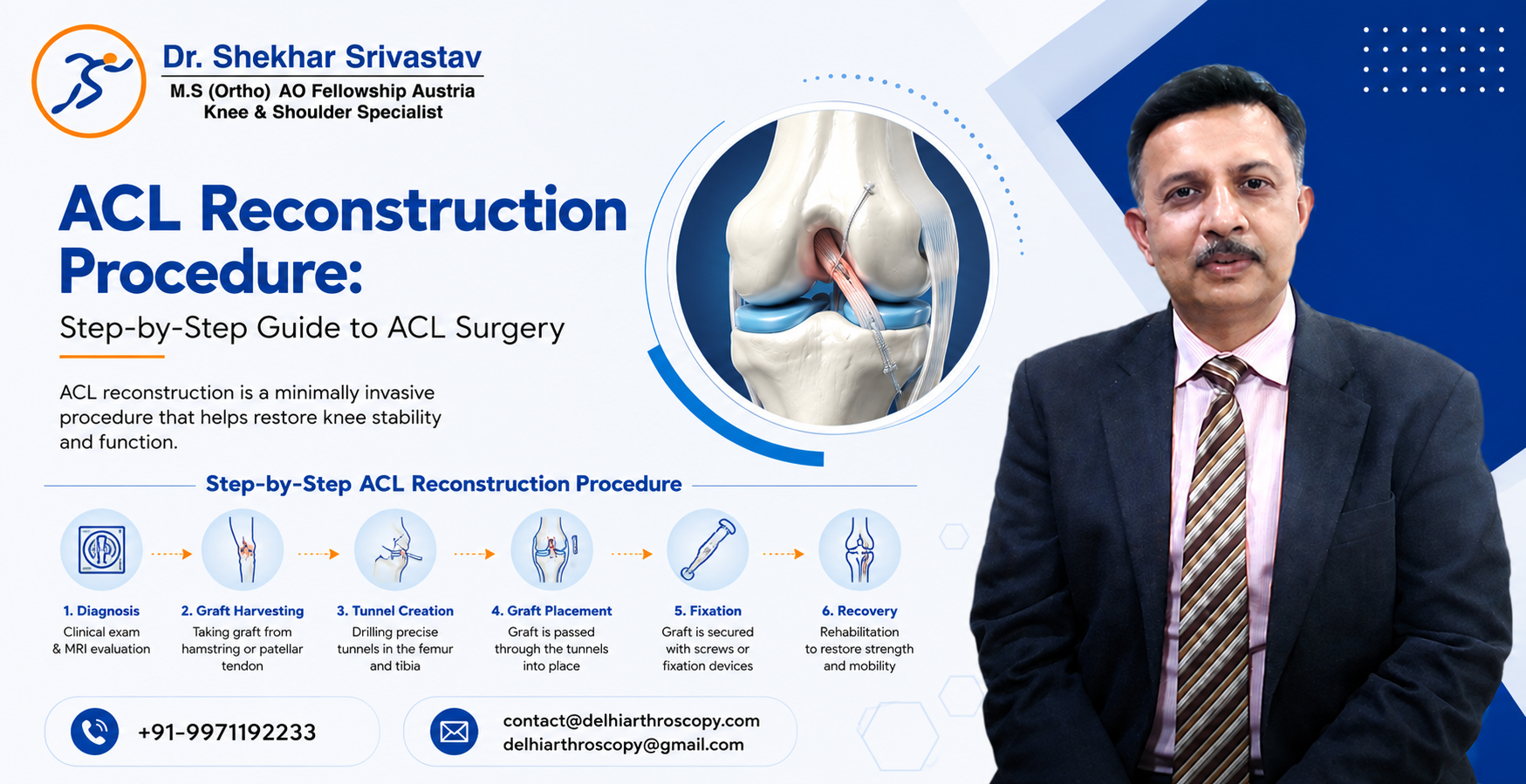
ACL Reconstruction Procedure: Step-by-Step Guide to ACL Surgery
What is an ACL Reconstruction Procedure? ACL reconstruction is a…

Why is arthroscopy not recommended?
Arthroscopy is an innovative, less invasive method of surgery to…