


ACL Surgery Recovery Time: Myths, Facts & What to Expect
An ACL tear is one of the most frequent injuries of the knee that impairs athletes, fitness lovers, and active adults. When conservative treatment fails to deliver results, ACL reconstruction surgery is the best way to bring back knee stability and function. However, patients mostly dread or fail to understand the recovery timeline. In this comprehensive guide on the recovery period after ACL surgery, we will debunk the biggest myths, uncover the real facts, and tell you precisely what you can anticipate during each stage of recovery.
This article is your ultimate, SEO-friendly guide to figuring out the truth of the road to recovery after an ACL injury and thus being able to get back to your active lifestyle without risking safety or losing confidence.
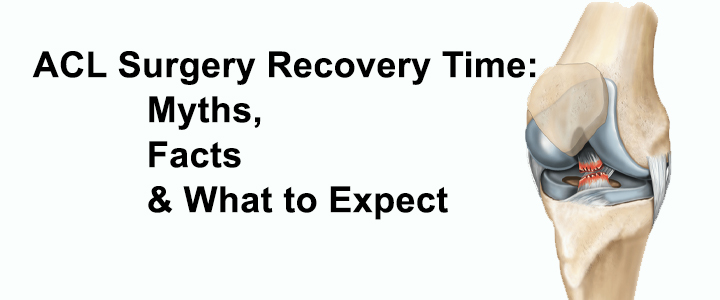
Comprehending the Concept of ACL Surgery and the Reasons for Recovery Time
The Anterior Cruciate Ligament (ACL) is the main stabilizer of the knee, it provides rotational control and stops the tibia from moving forward. In the case of a tear, if the injury is severe and occurred during a sport, a surgical operation is usually necessary in order to change the broken ligament for a graft.
Even though the surgery is done within 1–2 hours, that is not the real story. It takes quite some time for the body to get used to, heal, and strengthen the new graft. Hence, the recovery time after ACL surgery is between 6 and 12 months.
Common Myths About ACL Surgery Recovery Time
Most of these myths are just a jumble of the same facts we have been discussing. Let’s see what these myths are all about.
Myth 1: “Recovery will be complete after 3 months.”
Fact:
Returning to activities such as running, pivoting, or heavy workouts within 3 months is out of the question for any athlete or adult and should not be done under any circumstances. At this very early stage, the graft is still in the process of healing and is fragile. The majority of patients attain only basic mobility at 12 weeks.
Myth 2: “ACL surgery guarantees a faster recovery.”
Fact:
The operation itself is just the start. To a large extent recovery is dependent on physiotherapy, discipline, muscle strength, and lifestyle. Even if the operation is successful, without a proper rehabilitation program, recovery will be slow.
Myth 3: “Everyone recovers at the same speed.”
Fact:
Recovery time is different for each person and is influenced by factors such as: age, level of fitness, type of graft, and the degree of injury as well as whether the person is consistent with their rehab. No two patients have the same timeline.
Myth 4: “After surgery, the knee becomes good as new instantly.”h2>
Fact:
The knee will have swelling, become stiff and weak, in fact, these are the first signs of trauma. It is going to take quite some time to strengthen, gain flexibility and neuromuscular training before the knee will felt restored.
What Actually Affects ACL Surgery Recovery Time?
The main idea in figuring out recovery time is to realize what affects it and hence setting realistic expectations and avoiding disappointment.
1. Graft Type Used in Surgery
Several grafts function differently and thus their healing process differs.
Hamstring Graft
- Post-surgery pain is minimal
- Strong and quite flexible
- Recovery time is moderate
Patellar Tendon Graft
- Most used for athletes with high-impact sports
- Good stability
- First recovery stage discomfort may be longer but only a little
Quadriceps Tendon Graft
- Gaining popularity over time
- Good results after a long period
- Recovery rate is normal
To a large extent the time it will take to recover from an ACL surgery depends on the advice that your doctor gives you.
2. Pre-Surgery Muscle Strength
Patients who keep their quadriceps, hamstrings, and glute muscles strong before the operation are usually the ones who get better and faster post-surgery. Preparatory work (pre-surgery rehab) will help to improve the range of movement and will make the progress after the surgery smoother.
3. Quality and Consistency of Physiotherapy
This is the most important factor. Without the correct rehabilitation even the most successful surgery will not bring about the desired results.
Recovery gets accelerated when:
- Rehabilitation is started in the first 7 days
- Workouts are performed daily
- The patient’s strength, balance, and mobility are at a good level
- Support from the physiotherapist is always followed by the patient
Rehabilitation is slow when:
- The patient is not consistent
- During movement, the patient is afraid of hurting himself and therefore avoids exercise
- Although it is already time for strength and mobility goals to have been reached, they are still behind schedule
4. Age, Fitness Level & Lifestyle
The reason why young, active adults are often able to heal within a shorter period is that they have generally better muscle response. A life characterized by the lack of exercise, being overweight, or having low endurance and energy can lead to your healing process to be slowed down considerably.
What to Expect During ACL Surgery Recovery Time: Stage-by-Stage Timeline
The typical recovery journey is like the following:
Phase 1: Week 1–3 — Early Healing & Mobility
Goals:
- Decrease swelling
- Return to walking with crutches
- Restore muscle power through the quadriceps
- Walk with crutches
What to Expect:
You may experience stiffness, minor pain, and the knee might be hard to bend. Along with this, physiotherapy should be started as soon as possible.
Phase 2: Week 4–8 — Strength & Stability Building
Goals:
- Correct walking pattern
- Regain normal muscular strength
- Relieve pain
- Enhance balance
What to Expect:
Workouts such as mini squats, bridges, step-ups, and exercises for balance become your everyday rehab routine.
Phase 3: Month 3–5 — Functional Training
Goals:
- Increase range of motion
- Improve dynamic balance
- Start light jogging only if doctor approves
What to Expect:
The knee will feel firmer and stronger. Neuromuscular control can be regained by performing activities like lateral movements, jumps, and agility ladders.
Phase 4: Month 6–9 — Advanced Strength & Sports Training
Goals:
- Recover 80–90% of muscular strength
- Enhance speed, agility & stamina
- Perform sport-specific training
What to Expect:
Under trainer’s supervision, athletes begin sprinting, cutting, jumping, and practicing their sport.
Phase 5: Month 9–12 — Full Recovery & Return to Sport
Goals:
- Full strength restoration
- Feeling of total trust in the knee
- Being successfully tested on return to sport
What to Expect:
With rehab done properly, the majority of adults will be able to safely go back to playing sports, running, and taking part in other demanding physical activities.
Tips to Speed Up ACL Surgery Recovery Time
Your recovery can be smoother and quicker if you do the following:
✔ Initiate physiotherapy without delay
✔ Be consistent with your home exercise program
✔ Do Quad, Hamstring, and Glute Strengthening Exercises
✔ Keep your body weight within the normal range
✔ Do not exhaust yourself and don’t return to sports too early
✔ Apply cold therapy to help with swelling
✔ Concentrate on mental confidence and motivation
Conclusion
Knowing the time it takes for an ACL operation to heal: misconceptions, truths, and expected scenarios, is a way of helping patients to take the right decisions and keep their spirits during the recovery process. Getting better is not only about the ligament—it is also about regaining the muscle power, the stability, and the self-assurance. If you have the proper help and make a good use of the physiotherapy sessions, you will be able to come back to your sports activities in a safe and effective manner.
Related Posts
ACL Reconstruction Surgery: Full Guide to Faster Recovery
ACL Reconstruction Surgery – Advanced Knee Ligament Treatment by Dr.…
ACL Reconstruction Surgeon Delhi
Top ACL Reconstruction Surgeon Delhi – Your Complete Guide to…
Leading Orthopedic Surgeon for ACL Delhi – Dr Shekhar Srivastav
Leading Orthopedic Surgeon for ACL in Delhi – Dr. Shekhar…
One Reply to “ACL Surgery Recovery Time: Myths, Facts & What to Expect”
Comments are closed.