


ACL Tear to Full Strength: A Realistic Recovery Timeline Explained
An ACL tear ranks among the most difficult knee injuries to handle, particularly for athletes and people living active lifestyles. If you were to recover it fully and safely after a sudden twist, sports movement, or accident, it would take you a lot of time, patience, and discipline as well as your following a well-structured plan. In case you need to know how long it takes to regain a normal state, this manual stages the entire progression from an ACL tear to regaining full strength together with a detailed and realistic recovery timeline.
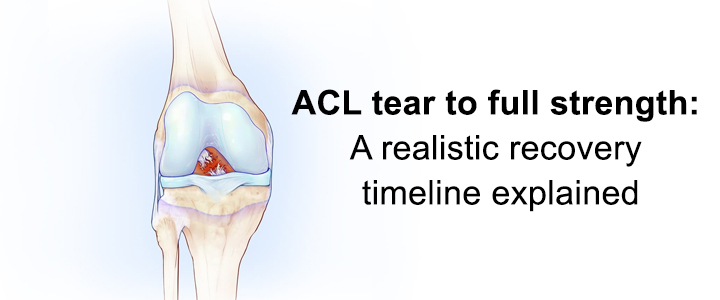
What Happens During an ACL Tear?
The Anterior Cruciate Ligament (ACL) is the main stabilizer of the knee joint and the supportive ligament during the movements that include jumping, turning, and rapid changes of direction. When the ACL is ruptured, the knee loses its stability; hence it becomes very hard to do the basic exercises of the body and play sports.
Information on an ACL tear classification system is as follows:
- Grade 1: Minor stretching
- Grade 2: Partial tear
- Grade 3: Complete tear
If it is a complete tear, the surgical reconstruction of the ligament followed by a multi-phase physiotherapy plan will be necessary. The understanding here is that why people take so much time to get to their full strength again.
How Long Does It Take to Recover After an ACL Tear?
On average, it takes about six to twelve months to regain full strength after an ACL tear, roughly considered as a rehab journey. The time frame may differ as some athletes may go back to their sport earlier with advanced training, whereas others may be slower due to their healing speed, muscle strength, or complications.
We have a detailed and realistic timeline below to explain the stages.
Phase 3: Month 2–4 – Functional Strengthening
Your physiotherapy between the second and fourth month will be more challenging.
Goals:
- Enhance muscle strength by using resistance
- Perform leg presses, mini squats, and step-ups
- Start cycling and elliptical workouts
- Increase joint stability
The majority of patients at this point report that they have returned to the normal daily movements and routine activities. Muscle strengthening = faster recovery.
Phase 4: Month 4–6 – Return to Light Sports Movements
With the help of the knee, which gained strength and flexibility, you can slowly return to more dynamic activities.
Goals:
- Jogging initiation
- Agility training commencement
- Perform controlled jumping
- Enhance coordination and balance
This stage gets your knee ready for higher-impact movements.
It is a big step towards a full return from an ACL tear.
Phase 5: Month 6–9 – Advanced Sports Training
Sports-specific training, focusing on performance, is the next step, after this.
Goals:
- Further improve sprinting speed
- Perform advanced plyometric exercises
- Practice cutting, pivoting, and direction changes
- Enhance knee confidence
The physio checks your knee’s ability to tolerate the increased load and range of motion.
Phase 6: Month 9–12 – Full Return to Sports
The last period is aimed at recovering not only the strength but also the performance and the stamina of the athlete once again.
- Have a fully stable knee joint
- Equal the strength of the healthy leg
- Be able to perform speeded-up agility drills
- Have the self-assurance to participate in a competition
By this point, the majority of patients who have undergone ACL rehabilitation reach full recovery from their ACL injuries.
Recovery Duration Depends on Various Factors
Different people recover differently in terms of time. The factors which determine the length of your recovery are:
1. The Tear Severity
It is only natural that a healing process for a complete tear takes more time than that of a partial one.
2. Age & Fitness Level
Generally, younger and physically fit people recover at a faster rate.
3. Physiotherapy Consistency
A lack of sessions or skipping an exercise can really slow your progress.
4. Lifestyle Habits
By eating well, drinking enough water, and getting proper rest, you are speeding up the recovery process.
5. Surgical Technique
Eventually, a quicker recovery may be possible through the use of modern reconstruction methods.
Knowing about these factors, you can set the goals for your rehabilitation accordingly and pick the right tactics for your recovery.
Elements to Give a Boost to Your ACL Tear Recovery
Keep Up with Your Physiotherapy
Doing physiotherapy regularly is not only beneficial for the body but also for the mind, as well as it gives a sense of progression and accomplishment.
Do Not Engage in High-Impact Activities Too Soon
Excessive activities such as jumping, running, and quick direction changes in the early stage of recovery might lead to re-injury.
Consume a Healing-Friendly Diet
Make sure your diet contains proteins, omega-3 fatty acids, vitamin C, and calcium-rich products.
Be Doctor’s and Physiotherapist’s Partner
Trying out different things on your own may cause inconveniences such as delayed recovery or even complications.
Apply Ice and Compression as Much as Possible
These help reduce tissue reaction and thus support the overall process of recovery.
When to See Your Doctor
Increased pain, prolonged swelling, knee locking or catching, difficulty walking, and delayed range of motion are some of the symptoms for which you should seek immediate guidance. Early intervention is the only way to stop the aggravation of your condition further down the line.
Conclusion
It takes a long time but is still possible to get back to full strength after an ACL tear. The healing process mostly lasts from 6 to 12 months during which the person has to undergo physiotherapy, follow a timeline, maintain a healthy lifestyle, and attend check-ups. Knowing the correct recovery time helps you keep your patience, willpower, and trust in your convalescence.
Related Posts
Affordable ACL Surgery Delhi
Affordable ACL Surgery Delhi: Your Complete Guide to Cost-Effective and…
ACL Reconstruction Surgery Steps
ACL Reconstruction Surgery Steps Yes, a teenager might undergo ACL…

Knee Arthroscopy in Delhi: A Modern Solution for Pain-Free Movement
Knee pain can seriously impact the way you carry out…
2 Replies to “ACL Tear to Full Strength: A Realistic Recovery Timeline Explained”
Comments are closed.