


Can ACL fully heal without surgery?
An Anterior Cruciate Ligament (ACL) injury ranks among the top commonly infamously the most frightening knee injuries scenarios in the world of sports and, generally, stages of vigorous physical activityplus individuals.The very utterance of the words “You have torn your ACL” prompts inquirers to ask immediately – “Is it possible for the ACL to heal fully without an operation?”
The response here is conditional i.e it depends largely on whether the tear is of the first, second or third degree and the severity thereof, as well as on one’s lifestyle and the extent to which he requires the knee to be stable. On the other hand, complete ACL rupture is seldom refurbished anatomically if solely by conservative means, although some partial ruptures may be treated without relief from the operatory.
We are to find out the facts of ACL recovery, self-healing potentials, and the point at which a surgical procedure is inevitable.
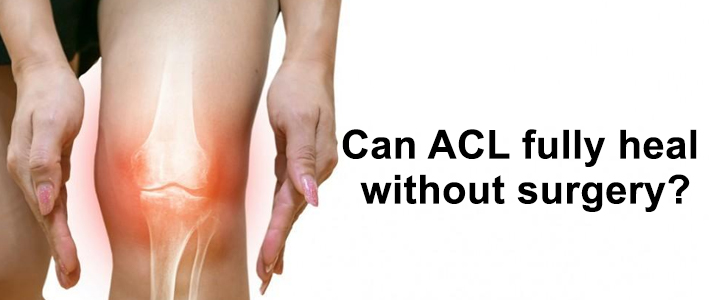
What the ACL is for
The Anterior Cruciate Ligament (ACL) is an essential part that links the femur (thigh bone) to the tibia (shin bone). It holds the knee stable during movement, particularly in sports or activities thatoreturn in the air, wildly, or utilize sudden directional shifts.
Once the ACL is torn — either partially or completely — the knee becomes unstable and cannot provide the same support as before. Most sufferers recollect hearing a “pop” accompanying the incident, and also experience pain, swelling and difficulty in walking.
As the ACL is not directly supplied via blood vessels, its capability to repair itself is very limited with respect to other body tissues. This is the reason why it is so seldom that people with full ACL rupture refrain from surgical intervention and still manage to restore their ligaments on their own.
ACL Trauma
Understanding the magnitude of the traumatological aspect can make your decision be that of whether an operation is compulsory for healing or not.
- Grade 1 (Mild Sprain): Ligament fibers have been overstretched but are remained intact. The extent of the condition the knee point can be safely considered stability-wise minor. 👉 Under conservative care inclusive of rest and physiotherapy, complete healing is realizable.
- Grade 2 (Partial Tear): Ligament fibers have been partly torn. The knee may feel unstable, especially during quick movements. 👉 May recover to some extent with conservative treatment, though a certain degree of instability might remain.
- Grade 3 (Complete Tear): The ACL has been entirely separated into two halves. The knee loses its ability to stabilize and thus may terminate its load-bearing function easily. 👉 The injury is irreversible through natural means and requires surgical intervention.
Can a Torn ACL Heal on Its Own?
⚕️ For Partial Tears (Grade 1 and 2)
When the ACL is partly torn, surgical interventions may be avoided, as non-surgical treatments are usually enough to regain function and stability. Those are:
- Rest and Activity Modification: Don’t put your knee through high-impact activities that cause it to strain.
- Physiotherapy: Muscular strengthening around the knee – mainly quadriceps and hamstrings – is the method of compensating for the ligament loss.
- Knee Bracing: It offers support to the knee and, thus, lessens the possibility of re-injury.
- Anti-inflammatory Treatment: It is used to relieve pain and swelling.
Partial tears, in certain conditions, can even heal to a point where daily life and some light exercise can be performed in time and with the right rehabilitation.
⚕️ For Complete Tears (Grade 3)
The answer is no, a complete tear of the ACL cannot mend naturally, even if time is allowed. The reasons for this are:
- The two torn ends of the ligament are far apart from each other.
- The tissue is poorly supplied with blood vessels, so healing is quite slow.
- Due to constant movement and lack of stability, scar tissue is not able to properly develop.
Although the pain and swelling may subside, the actual ligament remains torn, thus, your knee is still unstable and vulnerable to further injuries.
When Can You Avoid ACL Surgery?
Theoretically, surgery will not be needed if:
- The situation only involves a partially torn ACL and the extent of instability is minor.
- The individual is not engaged in sports or other intensive physical activities.
- The person is either elderly or lives a sedentary lifestyle.
- The person agrees to change activities and to not performing movements that would put pressure on the knee.
In a situation like this, a thorough rehabilitation plan can be not only effective but sufficient to recover stability and function at a level that is satisfactory.
When Is ACL Surgery Required?
If you have an ACL injury, reconstruction surgery is a must in case:
- You suffer from a complete tear (Grade 3).
- Your knee is very unstable and tends to give way or buckle when you walk or do exercise.
- You are a sports athlete performing activities that require jumping, twisting, or pivoting movements.
- You have additional injuries such as a meniscus tear or cartilage damage.
It is risky to postpone the operation in such situations as it may result in chronic instability, meniscus damage, and subsequent early arthritis.
Non-Surgical ACL Treatment
The non-surgical method suggested by a doctor usually covers the steps below:
1. Rest and Swelling Control
Apply ice packs, compression bandages, and keep your leg elevated to help reduce the swelling that occurs after an injury during the first few weeks.
2. Physiotherapy
The physiotherapist will guide through exercises to:
- Strengthen knee muscles
- Increase flexibility, and balance
- Make sure that there is no stiffness or muscle atrophy
3. Knee Brace Support
The use of a hinged or functional knee brace can offer the necessary external stabilization during the recovery process and daily routines.
4. Gradual Activity Return
Under supervision, you’ll slowly bring back physical activities — walking, cycling, or swimming — that the knee is able to do.
What Are the Risks if You Do Not Have ACL Surgery?
Non-surgical treatment may be an alternative for some patients, but still, those with complete tears who decide not to have a surgery may experience the following cons:
- Knee Instability: The knee may suddenly give way which in turn may cause the sufferer to injure himself again.
- Meniscus Damage: Instability can result in repeated attacks on the cartilage, thereby causing tears or degeneration.
- Early-Onset Arthritis: Continuous trauma to the joint surfaces may speed up the process of wear and tear.
- Reduced Athletic Performance: Athletes may find it difficult to execute movements that require them to quickly change directions or jump.
Success Rates of Non-Surgical Treatment
Studies demonstrate that:
- About 50% of individuals with a partial ACL tear manage to restore the stability of the knee without surgical intervention.
- Yet, more than 90% of those with a complete tear end up with an unstable knee if they do not undergo surgical reconstruction.
Consequently, the probability of a complete recovery without surgical intervention is only partial tears.
Is Physiotherapy a Viable Alternative to ACL Surgery?
Through physiotherapy the condition of the knee after a partial tear can be very much improved, but it is not possible to “regrow” or reattach a completely severed ligament.
Nevertheless, it is a very important “player” before and after the operation also – helping the patient to gain muscle strength, better joint control, and ensuring fast recovery.
In addition, for those patients who decide not to be operated on physiotherapy is a way of making the body ready and it will be able to generate different stability mechanisms.
Regenerative and Modern Options
Several new methods have the goal to improve natural healing of the ACL in mild injuries only, for example:
- Platelet-Rich Plasma (PRP) Therapy: Introduces platelets, which are taken from one’s own blood, to the area needing repair in order to speed up tissue regeneration.
- Stem Cell Therapy: As per the research, stem cells have the potential to aid the healing of the ligament, however, the results are still subject to further study.
These therapies are considered to be supporting agents, not surgical substitutes, in the case of complete tears.
Expert Opinion: Type of Tear Determines Healing
Orthopedic and sports medicine experts concur that:
- Partial ACL tears may heal after conservative treatment.
- Complete ACL tears almost always necessitate surgical reconstruction to regain full recovery and stability.
In case you’re not certain about the extent of your injury, have an MRI taken and see an ACL specialist. A tailored assessment is the best way to decide what is the most suitable treatment for your lifestyle and objectives.
Conclusion: Complete Healing Without Surgery Is Rare
So, can ACL fully heal without surgery?
✅ Yes, if it’s a partial tear and you follow a strict rehabilitation plan.
❌ No, if it’s a complete tear — because the ligament cannot reconnect or regain full strength naturally.
Non-surgical treatment may control symptoms, but for long-term stability, especially for athletes and active individuals, ACL reconstruction surgery remains the gold standard.
If you’ve injured your knee, consult a trusted ACL specialist who can assess your condition and help you choose the safest and most effective treatment path — whether surgical or non-surgical.
Related Posts
Can you get back to 100% after ACL surgery?
Can You Get Back to 100% After ACL Surgery? Anterior…
Dr. Shekhar Srivastav: Advanced Sports Injury Treatments in Delhi
Sports injuries should not be stereotyped as the athletes' problem.…
Who is the father of arthroscopy?
Patients typing the query "Who is the father of arthroscopy?"…