

The Complete Guide to ACL Injury Recovery Time for Active Adults
Knee injury could significantly alter the life of the affected. In case they are active adults, interest in running, gym workouts, cycling, trekking, or playing sports, their loss would be doubly felt. Of all knee injuries, the most common is probably an ACL tear, and, by recovery, it is the most frustrating for it requires a lot of patience and consistent rehabilitation. This blog is The Complete Guide to ACL Injury Recovery Time for Active Adults. It explains what factors influence the healing process, what can be expected from each stage, and how one can safely get back to leading an active lifestyle.
Understanding ACL Injury and Why Recovery Takes Time
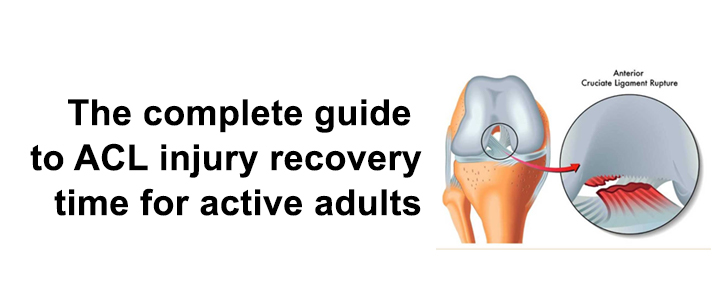
The Anterior Cruciate Ligament (ACL) is the biologically essential stabilizing ligament that is located in the human knee. It restricts excessive movement of the tibia in the forward direction and at the same time, keeps the rotation stability intact. The whole mobility is affected when the balance is disturbed due to the injury as well as the activities of daily living that become challenging.
Generally, the recovery period after an ACL injury is between 6 and 12 months for an active adult, and the outcome depends on the nature of the tear, the intervention strategy, and most importantly, the commitmnet of the person to the rehabilitation process. Apart from the healing itself, the restoration of full function, strength as well as the confidence in the knee is the ultimate goal.
What Affects ACL Injury Recovery Time in Active Adults?
The first step towards an effective and successful rehab is to recognize the factors that influnce the recovery from an ACL tear. Equally important is to design the plan in line with these factors and set realistic rehab goals. Here are the main contributors to the recovery process.
1. Severity of the ACL Tear
Different kinds of injuries that have been inflicted upon the same ACL-related area owe it the fact that various active adults might be talking about entirely different things.
Partial ACL Tear
- Can be healed without a surgical procedure
- Usually requires 3–6 months of rehabilitation
- Appropriate for non-contact activities such as cycling or gym workouts
Complete ACL Tear
- Usually needs a surgical reconstruction
- Recovery is generally longer than 8–12 months
- Is the prerequisite for sports activities, which are based on the pivoting technique (football, basketball, badminton)
The longer the tear, the more time is required for the patient to be fully recovered.
2. Age and Activity Level
A younger adult with a high level of fitness will typically be able to recover more quickly, as they generally have stronger muscles, are more flexible, and have a better healing response. An older adult, or a person leading a sedentary lifestyle, will most likely have to wait for more time.
Faster recovery is seen in adults who:
- Are physically strong in the lower body
- Continue to do physical activities regularly
- Have well-developed quadriceps and hamstrings
- Are disciplined in their exercise routines
Slower recovery may occur if:
- Those around the knee are elderly and muscles weak
- There is too much weight on the body
- The past injuries have made the joints weak
3. Treatment Approach: Surgical vs. Non-Surgical
Those adults who are full of life and would still want to perform their heavy-impact sporting activities or high-intensity workouts usually make a decision in favor of ACL reconstruction surgery.
Surgical Treatment
- The procedure is the most suitable for athlete and active workman scenarios
- It assures the knee can be used again in the long term without any hinderance
- The surgery is followed by a well-arranged physiotherapy program
- On average, it takes about 6-12 months for full recovery
Non-Surgical Treatment
- Best option for those who have a mild or partial tear of the ligament
- The method is a perfect fit for the low impact daily life of older citizens
- Apart from the training program, the patient should be doing exercises of strength and balance to get better
- Point of recovery: 3-6 months
The decision of treatment should be made by the orthopedic surgeon and the physiotherapist based on the patient’s lifestyle and his goals.
4. Quality of Rehabilitation
The structured rehab program featured in The Complete Guide to ACL Injury Recovery Time for Active Adults emphasizes that without regular physiotherapy, the pace of recovery slows down and is not as effective.
Good rehabilitation includes:
- Walking exercises for early stages of injury
- Gradual weight lifting and other strength exercises
- Balancing exercises and proprioception training
- Training for day-to-day activities as well as specific sports
- Frequent monitoring of progress
If a person skips stages or is not consistent in his/her exercise routine, it will result in delaying the recovery and there will be a risk of re-injury.
Stage-Wise ACL Injury Recovery Timeline for Active Adults
Understanding the stages of ACL recovery is made much easier with this timeline. Most active adults follow this sequence. The each stage has different goals, exercises, and expected improvements.
1. Week 1–3: Early Healing and Mobility
Targets:
- Get rid of swelling
- Recover full knee extension
- Make quadriceps work
- Develop basic mobility
Practice:
- Heel slides
- Straight-leg raises
- Ankle pumps
- Very light knee bending
The first step here is to get the recovery off the ground quickly and safely.
2. Week 4–8: Strength and Stability Building
Targets:
- Increase the strength of quadriceps and hamstrings
- Improve balance
- Reduce limping
Practice:
- Mini squats
- Step-ups
- Hamstring curls
- Glute bridges
- Balance board exercises
The time to recuperate from an ACL injury will be noticeably lessened by the power and control that you will have at this stage.
3. Month 3–5: Functional Training Phase
During this phase, adults regain their confidence and get familiar with using the knee in everyday and recreational activities.
Targets:
- Revamp dynamic movement
- Heighten knee stability
- Improve neuromuscular control
Activities:
- Easy jogging
- Side steps
- Ladder drills
- Controlled plyometrics
This is the point where active adults usually refer to their knee as “normal” again.
4. Month 6–9: Return-to-Sport or High-Intensity Activity
This phase sees people getting back to activities such as running, trekking, gym workouts, or even competitive sports.
Goals:
- Reach 90–100% strength level
- Get full agility back
- Be able to load the joint in a safe manner
Exercises:
- Sprint intervals
- Agility cones
- Jump training
- Sport-specific drills
Additionally, your physiotherapist will be the one to give you the green light after checking that you are strong and stable enough for full activity.
Speeding Up ACL Recovery for Active Adults
It is true that the recovery cannot be rushed but active adults may keep the following tips in mind to make progress faster:
✔ Initiate physiotherapy without delay
✔ Be diligent and perform home exercises regularly
✔ Strengthen both legs equally
✔ Don’t do high-impact activities before the injury has healed
✔ Opt for cold therapy to ease inflammation
✔ Be mentally strong and stay motivated
If the knee is treated properly and the patient follows the correct protocol leading to a full recovery, then long-term knee health and the risk of re-injury become minimal.
Conclusion
This blog post, The Complete Guide to ACL Injury Recovery Time for Active Adults, has provided the insight on the timelines, factors affecting, and the different stages of rehabilitation. A patient with an ACL injury has to be patient, but with a well-planned rehab program, consistent effort, and the right guidance, active adults will be able to make a comeback to their favorite activities even stronger than before.